
Build systems that hold when the scaffolding disappears.
Bright, capable students and adults can know exactly what to do and still struggle to begin, plan, prioritize, regulate stress, or follow through. SEC coaching turns those daily friction points into practical systems—built around real classes, responsibilities, routines, and goals.

It is not a motivation problem.
Executive functions are the cognitive control processes behind planning, working memory, inhibition, flexibility, self-regulation, and goal-directed behavior. A learner may understand the material but still miss deadlines, freeze at the starting line, underestimate time, or rely on reminders that create conflict.
Coaching makes these skills visible, teachable, and repeatable.
You may be seeing…
These are skill gaps—not character flaws.
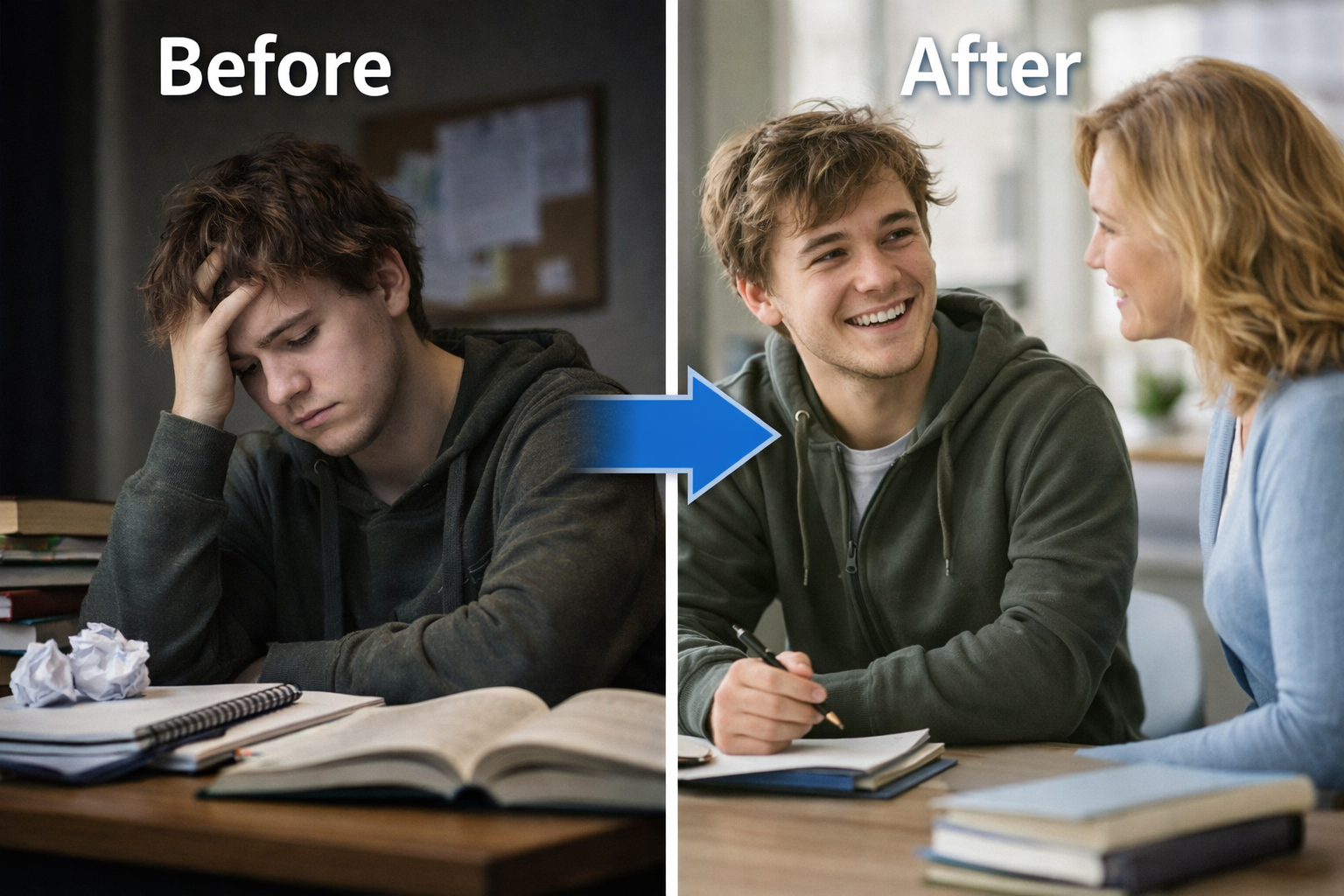
From avoidance and overwhelm to confidence and momentum.
When executive functioning challenges go unaddressed, even capable students can feel defeated. Structured coaching provides the practical systems, consistent accountability, and emotional relief that turn daily conflict into independent achievement.
The right support changes with the season of life.
Executive-function demands shift with each stage. Choose a pathway below to explore what is currently available.
Upper Elementary
Gentle support for building first planning routines, materials systems, and task initiation.
Middle School
Coaching timed to a growing workload, rotating classes, and the shift toward self-management.
High School
Planning, prioritizing, and follow-through support for students as they approach college and independence.
College & Graduate School
Student-directed coaching for syllabi, semester planning, task initiation, workload pacing, study systems, self-advocacy, independent-living routines, and accountability.
Adults
Executive-function coaching for adults navigating work, study, or major transitions.
Coaching happens in real life.
Assess and prioritize
Identify the highest-impact EF and regulation needs.
Build the system
Translate real deadlines, responsibilities, and routines into practical tools.
Practice and troubleshoot
Repeat strategies in the moments they are actually needed.
Measure and transfer
Review patterns, refine the system, and build greater independence.
SEC uses recurring coaching because executive skills develop through guided practice, feedback, and repeated application—not a one-time workshop.
Premium support, deliberately designed.
Individualized measurement
College clients complete a College EF + Regulation Assessment at the beginning and end to establish a baseline and review change. This is a performance snapshot—not a diagnostic test.
Nervous-system awareness
Coaching helps clients notice when stress is interfering with attention, initiation, planning, or follow-through and develop practical strategies for re-engaging and moving forward.
Accountability that becomes independence
External scaffolding is used deliberately so the client can increasingly run the system on their own.
Real-world application
We work from actual courses, syllabi, deadlines, work or clinical hours, routines, and goals—so practice transfers to daily life.
College removes the scaffolding. We help students build their own.
In college, a syllabus issued in week one may contain the deadlines that determine the grade. Add unstructured time, roommates, employment, labs or clinical hours, and responsibility for sleep and meals, and EF demands rise sharply just as external support falls away. College EF Coaching builds planning, prioritization, task initiation, study systems, regulation, self-advocacy, and follow-through using the student's actual semester.
What the first 12 weeks are designed to do
Build the baseline
Complete the assessment, build a semester calendar, capture tasks, and establish the first routine.
The honest middle
Novelty fades; troubleshoot friction and protect consistency as academic demands rise.
Systems start to click
Refine tools, strengthen follow-through, review measured change, and decide how support should continue.
SEC recommends this as an initial commitment, not a guarantee of a fixed outcome.
Choose the level of structure—not a one-size-fits-all package.
Foundations
10 sessions
Establish one complete system for deadlines, weekly planning, task initiation, and workload review; individualized goals and action steps.
Program investment is reviewed during your consultation.
Performance
20 sessions
Practice and refine the system across an academic term.
- Personalized EF Playbook
- Weekly accountability message (up to 5 minutes)
- Authorized support-person update every 4 weeks, where selected and permitted
Program investment is reviewed during your consultation.
Accelerator
30 sessions
Higher-frequency support for demanding course loads, academic recovery, major transitions, or stronger transfer to independent living.
- Personalized EF Playbook
- Weekly accountability message (up to 5 minutes)
- Authorized support-person update every 4 weeks
- Final progress review
Program investment is reviewed during your consultation.
A standard appointment reserves 60 minutes, including approximately 50 minutes of direct coaching plus documentation, scheduling, assignments, and brief follow-up. Final inclusions and current investment are confirmed in the service agreement.
Independence with the right people in the right roles.
Adult college clients direct their coaching. A parent, partner, mentor, or other support person may be involved only with the student's written authorization. Financial responsibility alone does not authorize access to coaching details.
Support is designed to reinforce the student's systems—not take over the work.

Evidence-informed, honestly described.
SEC draws on executive-skills frameworks and research on structured, recurring coaching, individualized goal setting, practice, feedback, and accountability. We apply these ideas thoughtfully to each client's real context—without overstating what any one approach can guarantee. Research does not establish one universal number of sessions for every person, and it does not guarantee an individual outcome.
Selected References
- Dawson, P. & Guare, R. — Smart but Scattered executive-skills frameworks
- Diamond, A. (2013) — Executive functions
- Parker, D. R., et al. (2011) — Coaching college students with EF challenges
- Prevatt, F. & Yelland, S. (2015) — Coaching for ADHD and EF
Listed to describe the foundation of our approach, not to claim endorsement by these authors.
You are never the one relaying messages between specialists.
Families working across more than one of our practices get a single point of contact who oversees the whole plan. The college counselor, the executive function coach, and the academic specialists work from the same information about your student.
Executive Function Coaching FAQ
Start with a conversation, not a contract.
Tell us about the challenges you are experiencing, what you have already tried, and what greater independence would look like. We will help you determine whether executive functioning (EF) coaching is the right fit and which age-based program best meets your needs.
Executive Function Coaching at SEC Experts HQ | Savannah Educational Consultants is educational and performance-based, distinct from psychotherapy, medical treatment, diagnosis, crisis services, and legal advice. SEC does not guarantee grades, GPA, test scores, or other specific outcomes. Serving the Coastal Empire and Southeast Georgia families in person and clients nationwide through online services.
